Choroideremia
Choroideremia is an x-linked recessive disease affecting about 1 in 100,000 people, characterised by degeneration of the choroid, retinal pigment epithelium (RPE) and retina of the eye.
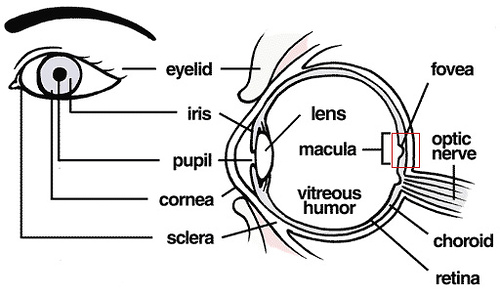
Fig 4. Anatomy of the human eye.
Image courtesy of flickr under the creative commons licence
Choroid: Lies between the retina and sclera of the eye, and contains connective tissue the blood vessels which nourish the back of the eye
Retinal Pigment Epithelium: A pigmented later (brown in humans) attached to the choroid and specifically nourishes the retina. The cells in this layer are hexagonal and packed with pigment granules. This is also where trans retinol is isomerised to 11-cis retinal.
Retina: A multilayered section of the eye which contains many different cell types, including photoreceptors (rods & cones) which react to light.
Symptoms
 Male sufferers usually develop night blindness in their teens first, then as the disease progresses and the layers of the eye degrade, there is constriction of the visual fields eventually leading to complete blindness by middle age. The disease is progressive, but the rate of degeneration varies from patient to patient. Female patients don't usually show symptoms as they will usually have a non-effected x-chromosome. However, patchy pigmentation of the iris and degeneration of the RPE are sometimes seen.
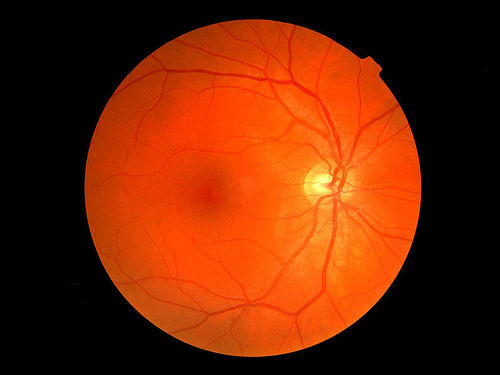
Fig 5. The retina of a human eye
Image courtesy of flickr under the creative commons licence
Cause
The mutations in the genome which cause this disease are located on the x chromosome. The molecule said to be affected by the mutations is REP-1 (Rab effector protein - 1).
REP-1 is needed to bind to Rab27a and stabilise it for geranygeranylation (a form of prenylation). If this doesn't occur, then Rab27a will not be activated and it will remain in the cytoplasm. This means vesicles regulated by Rab27a won't be targeted to their specific membrane and their cargo will remain undelivered.
Without this membrane trafficking, the affected layers of the eye cannot survive and consequently degrade. This causes the blindness seen in Choroideremia.
Treatment
Currently there is no treatment for Choroideremia, however there is now a diagnostic blood test which can be performed if Choroideremia is suspected.
It is also possible to test for Choroideremia prenatally in some cases.
Useful Links