Griscelli Syndrome
Griscelli Syndrome type 2 is a rare autosomal recessive disease, worldwide there has been around 60 cases ever reported. The disease has been mapped to chromosome 15q21 where the Myosin 5a and Rab27a genes lie.
Symptoms
Partial albinism (pigmentary dilution) of the skin and hair involving pigment clumps in hair shafts (the rest of the hair is silvery in colour due to lack pof pigmentation) and melanosome accumulation in melanocytes.
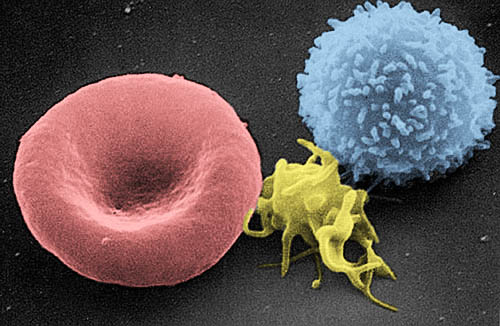 Haemophagocytic syndrome, in which t-lymphocytes become defective and macrophages phagocytose blood components and t-lymphocytes become defective. This disease is characterised by anaemia, jaundice, fever, enlarged liver & spleen, lymphadenopathy and pancytopenia.
Fig 6. Red and white blood cells
This image courtesy of wiki commons under the creative commons licence
The symptoms of Griscelli Syndrome type 2 manifest in sufferers ages 4 months to 4 years and is often diagnosed between the ages of 4 months to 7 years.
Sufferers often also suffer from seizures, neurological problems and usually premature death due to Haemophagocytic syndrome.
Cause
Griscelli Syndrome type 2 (GS2) is thought to be caused by mutations in the Myo5a and Rab27a genes.
The Myo5a gene encodes the myosin 5a protein. Myosin 5a is a motor protein and part of a cell's cytoskeleton: the molecular machinery in a cell made up of different myosin and actin filaments which facilitates movement of vesicles etc throughout the cytoplasm of the cell.
It is thought that the mutation in the Myo5a gene causes the partial albinism seen in Griscelli Syndrome type 2. Without myosin5a there is reduced transport of melanocytes (the vesicles which carry melanin, a light-absorbing pigment), resulting in the patchy colouring of hair and skin in GS2.
Rab27a has been shown to be important in regulating release of perforin (a cytotoxic protein) from cytotoxic T-lymphocytes. It is believed that when mutated, Rab27a can no longer regulate docking and fusion of the vesicles containing perforin. This lack of perforin release is linked to haemophagocytic syndrome seen in Griscelli Syndrome type 2.
Treatment
The only treatment that can actually cure Griscelli Syndrome type 2 is an allogeneic hematopoietic stem cell transplantation (HSTC), however this treatment has not yet been perfected and can result in various side effects, some fatal.
There are no other treatments for this disease and many sufferers die.
Research
Rab27a is Required for Regulated Secretion in Cytotoxic T-Lymphocytes